
This article was originally written for The Innovation News Network. You Can visit their website here.
Too many households in the UK live in homes that are expensive to heat, uncomfortable, and damaging to health. This can be true even in homes with measures such as double glazing, insulation, and other efficiency measures already installed. The Sustainable Energy Association (SEA) has published its bold new plan to address these issues, while driving up standards in domestic energy efficiency sector.
The problem
The UK building stock is among the oldest and least efficient in Europe. It’s also highly diverse, with different homes requiring different measures and solutions to help make them fit-for-the-future.
Around 28 million homes will require retrofit measures, yet fabric efficiency measures remain a costly measure, and do not always deliver the expected results for occupants.
Currently, all homes require an Energy Performance Certificate (EPC) when they are built, sold, or rented out. When recommending energy efficiency measures for a home, an assessor relies on EPC data. However, a building’s predicted performance does not always reflect how it performs in practice. Two properties that appear identical may behave very differently, and standardised methodologies that calculate a home’s energy performance may not accurately predict the performance of every individual home.
This is called the performance gap. The performance gap is the difference between the predicted efficiency of a home based on its EPC data, and its actual in use performance. There are limited policy mechanisms currently in place that assess how homes perform under real-world conditions.
Consequently, despite many homeowners, occupants, and new build developers taking steps to create more efficient homes, the specific low carbon heating or fabric efficiency measure used may not be the most suitable solution for that particular property.
Research on the effect of the performance gap on building fabric installed in individual dwellings has highlighted the scale of the issue. Leeds Beckett University, the University of Salford, and Loughborough University found that EPC-based predictions are both overestimating and underestimating the reduction in whole house heat loss created by installing fabric efficiency measures.
The SEA’s call for measured performance
The Government is currently consulting on the use of Smart Meter Enabled Thermal Efficiency Ratings (SMETERs) as part of reforming the way the EPC model works. SMETERs are technologies that measure the thermal performance of specific homes using smart meters and other data. The technology would, in real-time, calculate the thermal performance of a home, removing the reliance of calculation methods in favour of real-life data.
Technologies used may include wireless sensors, heating controllers, radiator monitors, air temperature sensors, and more.
Not only would SMETERs strengthen our understanding of how to make existing buildings more efficient, but they could also offer greater accountability in newbuild delivery. The Future Homes and Buildings Standard (FHBS), which will now come into force in March 2027, requires that new buildings must be retrofitted with low carbon heating and high levels of energy efficiency. SMETERs could ensure that housebuilders build homes that achieve these new standards in practice, not just on paper.
Currently, a valid EPC is required when you buy or sell a home. Incorporating SMETER data within this requirement could also ensure buyers are more informed when buying their homes, offering reassurance that existing measures installed are operating in the way they should be.
In 2022, the Government ran a technical evaluation that examined organisations developing their own SMETER technologies, helping to understand how the products could measure a home’s Heat Transfer Coefficient (HTC) more accurately than predicted Reduced Data Standard Assessment Procedure (RdSAP) information. Eight organisations participated in the study, including one of the SEA’s members, Build Test Solutions (BTS).
The SEA’s proposal
The SEA proposes a phased approach to the rollout of SMETER technologies. This approach would offer stronger accountability in newbuild delivery, while also allowing time for the industry to adapt, building confidence while generating meaningful evidence that the technology works.
- Phase 1: Housebuilders would be invited to deploy SMETERs in around 10% of their new homes. Where monitored properties fall short of minimum thresholds, a remediation framework could outline expectations for addressing shortfalls.
- Phase 2: As familiarity with the technology grows, government could introduce independently randomised sampling to provide a more representative picture of performance across the sector.
- Phase 3: Homeowners and landlords would be able to commission a SMETER assessment on request once a property is occupied.
The SEA proposes that SMETER data is available to the public on a national new build performance register. This would drive up standards across the new build sector, resulting in higher quality new builds.
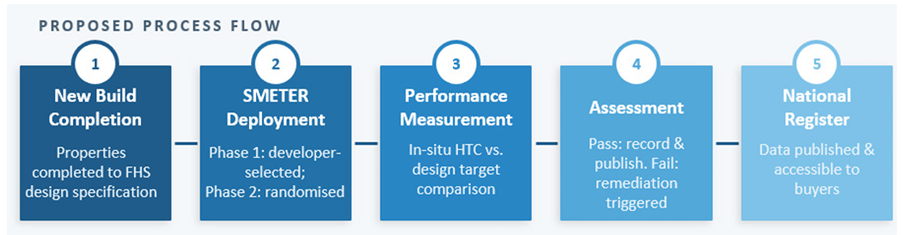
The SEA also suggests that developers be required to lodge a performance bond as a condition of planning consent or building regulations sign-off, which would be released once SMETER monitoring confirms that a property meets its performance requirements.
SMETERs could also drive-up standards in the new build sector in other ways. These could include incentives in the form of a stamp duty reduction for buyers commissioning a SMETER assessment, or a requirement that estate agents advertise SMETER data for a home alongside EPCs.
Application to existing homes
In existing homes, SMETERs could accelerate improvements to older homes and buildings. The SEA proposes incorporating SMETER data into existing subsidy schemes for low carbon heating such as heat pumps, informing sizing and specifications to increase installation quality.
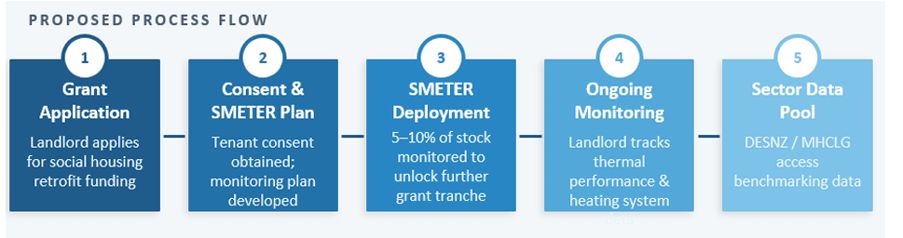
The SEA have placed particular emphasis on social housing. Social housing tenants are disproportionately exposed to the consequences of poor building performance, creating higher energy bills and less healthy homes. They recommend making SMETER deployment eligible for capital funding under social housing programmes. To support this, government might consider quotas for SMETER deployment, tenant consent, a sector wide dataset, and tenant data access.
A national SMETER dataset spanning social housing, private rental, and owner-occupied properties could also offer government an increasingly representative view of stock performance overtime.
To conclude
The SEA has developed a comprehensive policy paper making the case for measured performance in government policy. This paper, informed by their diverse member base and cutting-edge analysis team, highlights how SMETER data could drive up standards across all sectors, without leaving certain occupants and buildings behind.
The full paper outlines how government may collect SMETER data across new and existing buildings, social homes, the private rented sector, empty and vacant properties, and how the technology can be incorporated within existing policies and regulations across both England and Wales.
At a time when an estimated 28 million homes will require improvements and low carbon heating upgrades by 2050, measuring how our efficient our homes really are is paramount.