
This article was originally written for our member NAPIT's Competent Person's Magazine. You can read this article in full by signing into NAPIT's member portal.
The Sustainable Energy Association (SEA) is on a mission to create living and working spaces fit for future generations. As we decarbonise the UK's building stock, we must also prioritise the creation of warm, comfortable, and healthy homes that don't cost the earth, while working towards eradicating fuel poverty.
In order to do this, we believe that a new approach is needed to phase out fossil fuel heating, one that does so gradually, drives up the efficiency levels of existing heating systems, and one that recognises the range of different heating technologies available. This approach should recognise the diverse needs of our homes and buildings, while providing a range of low carbon alternatives suited for each and every circumstance.
We have therefore developed a white paper which proposes a stepped approach to the final phase-out of new fossil fuel heating systems through a Carbon Intensity Standard (CIS). Over the 2029-2036 period, legislation under our plan would progressively reduce the permitted carbon emissions from new installations or the replacement of major components of heating systems.
The proposal also avoids picking one technology, and sets out a long-term, technology agnostic, market-driven decarbonisation of domestic space and water heating. It allows for the installation of low-carbon alternatives such as heat pumps, infrared, storage heaters and other forms of smart electric heating, benefiting both consumers and industry.
This would give investors the confidence to invest in new technologies and infrastructure over a longer period of time, against a stable and predictable regulatory background.
How it works
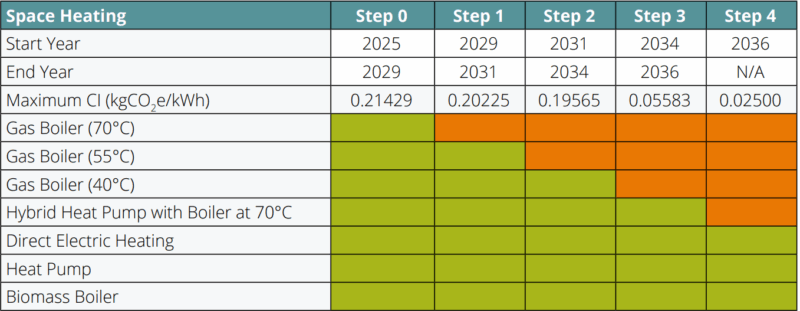
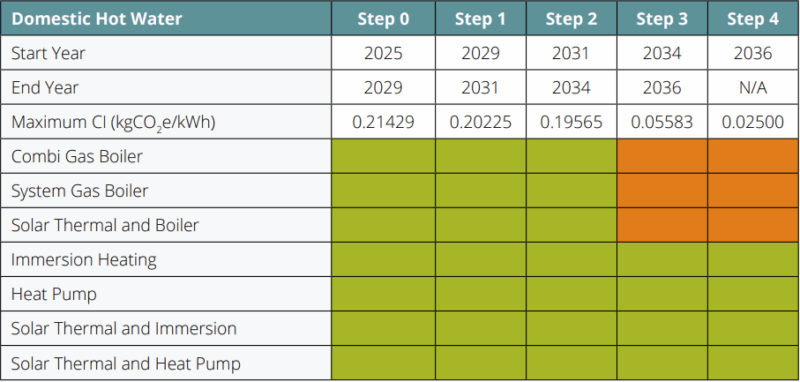
As demonstrated by the tables above, the first two steps of our proposal allow today’s dominant technology – condensing gas boilers – to continue to be installed, but progressively requires changes to their flow temperatures, to maximise efficiency. This way, the UK can begin to see results from policies to reduce emissions from buildings, even in homes that have not yet upgraded to low carbon alternatives. Increasing the efficiency of fossil fuel boilers will also make heat pumps and other low carbon technologies more competitive by comparison.
In Step 3, the permitted carbon intensity standard is calibrated to be the equivalent of a hybrid heat pump system, with the heat pump component delivering 80% of the space heating demand. This 80% contribution standard is based on findings from trial data obtained by the University of Salford, the Energy House Labs, and Nesta, which demonstrated that high-quality hybrid installations can achieve this level of heat pump performance annually[1].
The final step, when fossil fuel systems in any form will no longer be able to meet permitted carbon emission standards, is based on a carbon intensity equivalent of direct electric heating, which is by the time the grid is expected to be all but fully decarbonised.
Benefits for the supply chain
We believe that our proposal provides will improve market certainty, providing a clear regulatory framework for the phase out of fossil fuel heating systems.
The proposal is unique in the way it does not propose the removal of existing, well-functioning boilers, applying only to where a new boiler or other major components (such as the majority of radiators) require changing.
Our policy proposal also affords enough time for the wider supply chain to evolve and prepare for an increase in demand for low carbon heating systems, building up the installer workforce capacity and the domestic manufacturing capacity to create a thriving UK market for the technology.
If you are interested in learning more about our Carbon Intensity Standard initiative, you can read it in full on our website.